


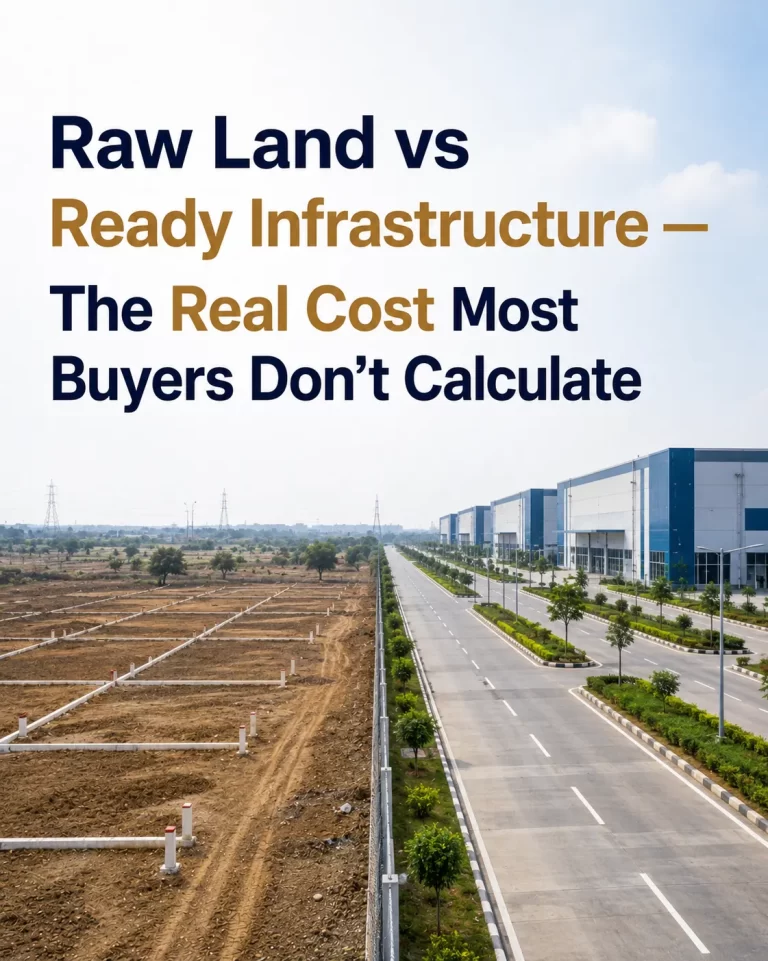
Is Raw Industrial Land Really the Cheaper Option?
When comparing industrial properties, many buyers focus on the purchase price alone.
At first glance, raw industrial land often appears significantly less expensive than a plot within a fully developed industrial estate. In many cases, the difference can range between 20% and 40% per square yard, making raw land seem like the more economical choice.
However, the purchase price is only one part of the overall investment.
The real comparison begins after the land is purchased—when the process of making the property operational starts.
What Does “Raw Industrial Land” Actually Mean?
Raw industrial land may have clear ownership and valid Non-Agricultural (NA) approval, but it often lacks the essential infrastructure required for industrial operations.
Depending on the location, buyers may need to arrange:
- Internal access roads
- Electrical connections
- Water supply
- Drainage systems
- Effluent treatment facilities (CETP/ETP)
- Utility approvals
Each of these requires additional investment, regulatory approvals, and time before a factory or warehouse can begin operations.
In contrast, a developed industrial estate is generally designed to provide much of this infrastructure from the outset.
Understanding the Hidden Costs
The difference between raw land and a developed industrial estate becomes clearer when additional development expenses are considered.
Electrical Infrastructure
Establishing power for an industrial unit may involve:
- Utility applications
- Load approvals
- Infrastructure charges
- Transformer installation (where required)
The overall cost depends on the business’s power requirements and the availability of nearby infrastructure.
Project timelines may also vary depending on approval processes.
Water Supply
Industrial operations require a reliable water source.
Depending on the location, buyers may need to:
- Install borewells
- Apply for municipal or industrial water connections
- Develop supporting water infrastructure
These costs are often not included in the initial land purchase price.
Effluent Treatment Requirements
Manufacturing units that generate industrial wastewater generally require access to a Common Effluent Treatment Plant (CETP) or an approved alternative treatment system.
Where no common facility exists, businesses may need to establish independent treatment infrastructure, which can substantially increase project costs.
Internal Roads and Site Access
Industrial operations depend on smooth movement of heavy vehicles.
If internal roads or approach roads are not already developed, buyers may need to invest in improving site accessibility before commencing operations.
The Cost That Is Often Ignored: Time
Infrastructure delays can have a significant financial impact.
Every month that a manufacturing unit or warehouse remains non-operational may result in:
- Loan interest
- Land holding costs
- Administrative expenses
- Contractor payments
- Delayed business revenue
Although these expenses are not always included in initial project estimates, they can meaningfully affect the overall return on investment.
For many businesses, delays may become more expensive than the initial savings achieved through purchasing lower-priced land.
What Does a Ready-Infrastructure Industrial Estate Offer?
A well-developed industrial estate is designed to reduce many of the uncertainties associated with developing raw land.
Depending on the project, buyers may benefit from infrastructure such as:
- RCC internal roads
- Dedicated power infrastructure
- Water supply
- Drainage systems
- Operational CETP facilities
- Planned utility connections
Because these facilities are developed at the project level, businesses can often focus more quickly on factory construction and operational planning.
The availability of ready infrastructure may also reduce project coordination challenges and improve overall execution timelines.
Why Developer Experience Matters
Infrastructure development requires coordination with multiple government departments, utility providers, and regulatory authorities.
Developers with experience in delivering completed industrial estates often have established processes for managing these requirements.
For example, GM Group has developed multiple industrial parks across South Gujarat with infrastructure planned as part of the overall project development.
Businesses evaluating industrial projects may find it helpful to review completed developments to understand how infrastructure has been delivered in practice.
How to Compare the Two Options Fairly
Instead of comparing only the purchase price, buyers should calculate the total cost of becoming operational.
A practical comparison should include:
Raw Industrial Land
- Land purchase price
- Utility infrastructure costs
- Water and drainage development
- Road development (if required)
- Regulatory approvals
- Holding costs during project delays
Ready-Infrastructure Industrial Estate
- Plot purchase price
- Included infrastructure
- Utility availability
- Estimated project timeline
- Earlier operational readiness
When evaluated using the total project cost rather than land price alone, the price difference between the two options often becomes much smaller than it initially appears.
Final Thoughts
Raw industrial land can be a suitable option in certain situations, particularly for businesses with long project timelines, specialized infrastructure requirements, or the ability to manage multiple development processes independently.
However, for many manufacturers and industrial investors, a ready-infrastructure industrial estate offers advantages that extend beyond convenience. Reduced project risk, faster operational readiness, simplified approvals, and greater cost predictability can all contribute to a more efficient investment.
Rather than focusing solely on the price per square yard, buyers should evaluate the complete financial picture—including infrastructure costs, project timelines, operational delays, and long-term business objectives—to make the decision that best aligns with their needs.